Key Takeaways
- ✓ Broadband Facts labels are standardized fact sheets required by the FCC, similar to nutrition labels for internet plans, and mandatory for most major providers as of 2025.
- ✓ Every label uses the same format, so you can compare monthly price, speeds, data caps, contract terms, and fees side by side.
- ✓ Look past the promo rate: check the full monthly price after any intro period ends, plus one-time and equipment fees.
- ✓ Upload speed matters as much as download. Fiber plans usually show symmetrical speeds, which help with video calls, backups, and gaming.
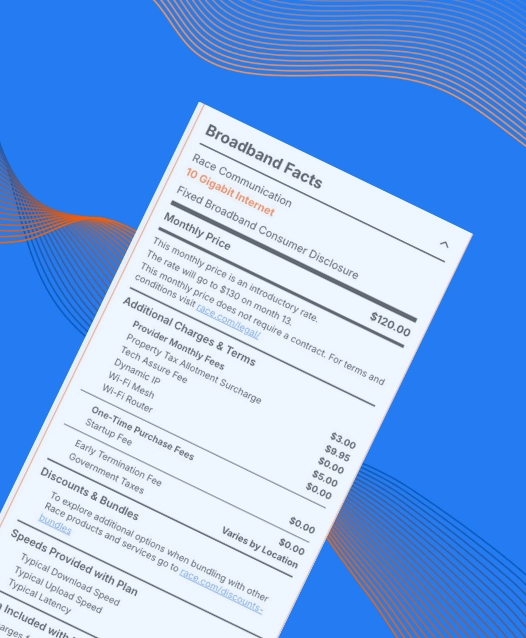
- ✓ Race Communications’ label shows no contracts, unlimited data, symmetrical speeds, a router included, and free professional installation.
In an effort to make internet service more transparent, the Federal Communications Commission (FCC) introduced Broadband Facts: a standardized way for internet providers to share key details about their services.
Much like the nutrition labels on food products, these broadband nutrition labels are designed to be simple, clear, and informative.
As part of recent FCC internet regulation, these labels are now required by law for most major broadband providers. They give you a side-by-side view of plan details, so you can choose your internet plan easier.
Shopping for internet has always been confusing. With vague promotional offers and inconsistent information, many customers don’t realize what they’re truly signing up for. The FCC broadband labels aim to fix that by putting the facts front and center.
In this guide, we’ll explain how to read a broadband label and how different providers compare: from Xfinity broadband labels and AT&T broadband facts to the Broadband Label Spectrum and the Frontier Broadband Label, including how Race Communications stacks up against them.
What Are Broadband Facts?
Think of broadband labels like the internet world’s version of a food nutrition label. Instead of calories and sugar, you get details like speed, price, and data limits. These labels help you understand exactly what you’re paying for when you sign up for internet service.
Required by the FCC broadband labels rule, these standardized labels became mandatory for most ISPs in 2025. That means companies like Xfinity, AT&T, Spectrum, Frontier, and Race Communications now have to present their internet plans using the same clear format.
So, what is a broadband label? It’s a one-page fact sheet that shows you:
Typical download and upload speeds
Monthly price (including equipment fees, discounts, and taxes)
Data caps or throttling policies
Contract terms and any early termination fees
Latency and performance during peak hours
This move toward transparency makes it easier to compare internet providers apples-to-apples, and that’s exactly what the broadband facts label is meant to do.
Understanding Your Broadband Label
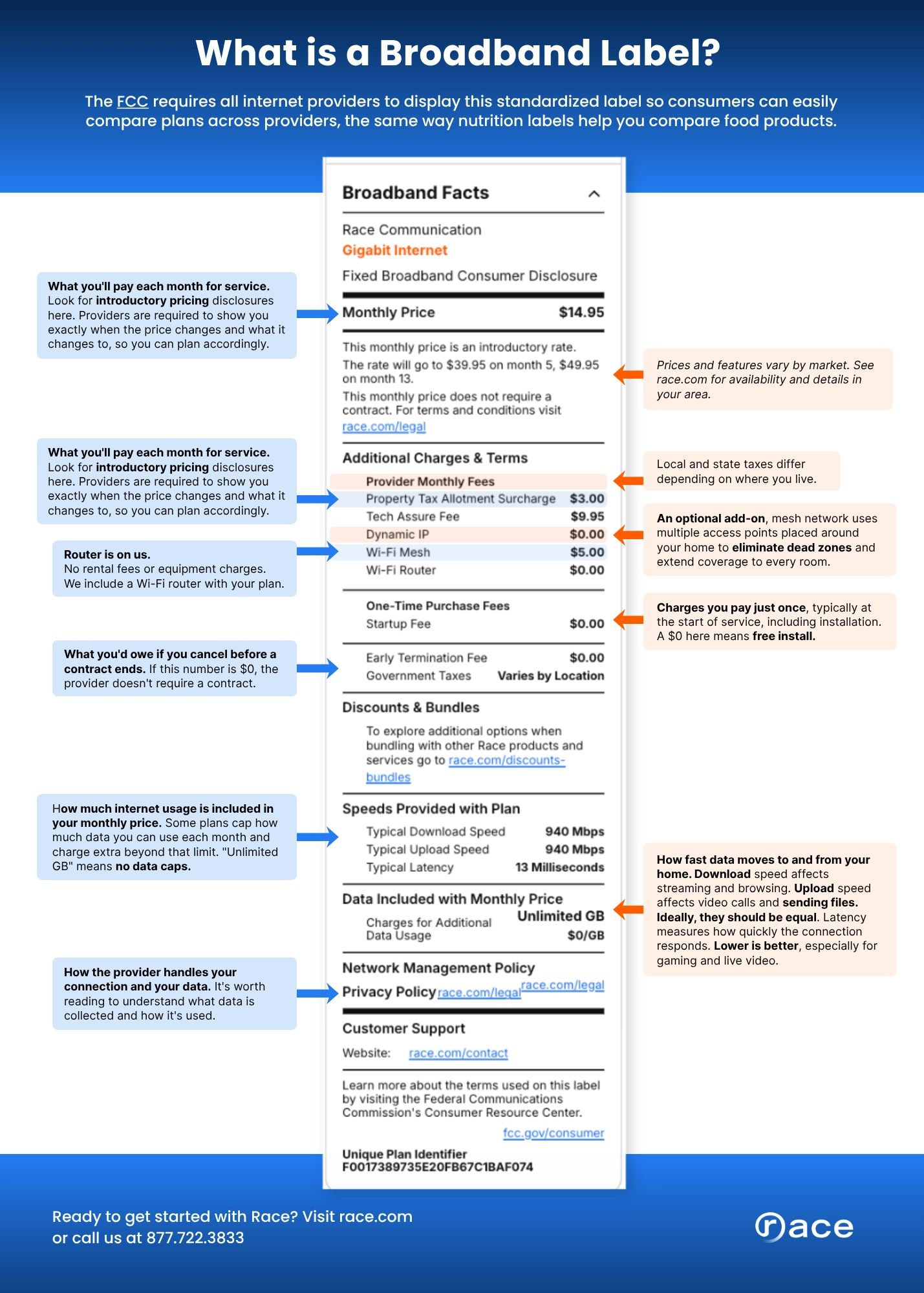
Each Broadband Facts label follows a consistent format so you can easily compare plans. Here’s what each section means and what to look for:
| Label Category | Explanation | What to Look For | Examples |
|---|---|---|---|
| Monthly Price | Shows the base monthly cost. May be an introductory rate that changes after a few months. | Final monthly price after promo ends and how long the intro rate lasts | Spectrum: $70 intro, jumps to $100 |
| Length of Contract | Indicates if you’re locked into a contract, and for how long (12, 24, or 0 months). | No contract plans | Xfinity: No contract required, but no price lock unless you commit to 5 years |
| Provider Monthly Fees | Recurring charges for things like equipment rental, modem lease, or Wi-Fi service. | No fees for routers or equipment | Xfinity: $15/mo for modem, $25/mo for xFi Complete |
| One-Time Fees | One-time costs such as installation, activation, or setup fees. | $0 installation fees | Xfinity: $39.99 to $100 install fee Spectrum: $65 professional install |
| Early Termination Fee | A fee you may pay if you cancel your service before the contract ends. | Plans with no early termination fee (ETF) | Frontier: Up to $100 |
| Government Taxes | Details on whether taxes are included in the price or vary based on your location. | Make sure taxes are included to avoid surprises | Most providers list “Varies by location” |
| Discounts & Bundles | Shows available discounts if you bundle with other services (TV, phone, mobile). | Discounts via autopay, bundles, or loyalty programs | Bundling with TV, mobile, or voice may reduce your monthly rate |
| Speeds (Download / Upload / Latency) | Lists typical download and upload speeds and latency (response time). | Speeds over 300 Mbps, under 30ms latency, symmetrical uploads | Xfinity: 1100 down / 306 up Spectrum: Only 40 Mbps up |
| Data Included / Caps | States how much data you can use per month, unlimited or capped. | Unlimited data | Xfinity: 1.2 TB cap unless you pay $30/mo for unlimited |
| Extra Data Charges | The per-GB cost if you exceed your monthly data cap. | Unlimited data | Xfinity: 1.2 TB cap unless you pay $30/mo for unlimited |
| Network Management Policy | Explains if the provider slows your connection during busy hours. | No throttling or slowdowns during peak usage | All link to policy. No standout. |
| Privacy Policy | Describes how your data is collected, stored, or shared. | Clear policies that respect user privacy and data protection | All link to policy. No standout. |
| Customer Support | Provides support contact details: phone and website. | Fast, accessible support through phone or website | All providers list contact info. |
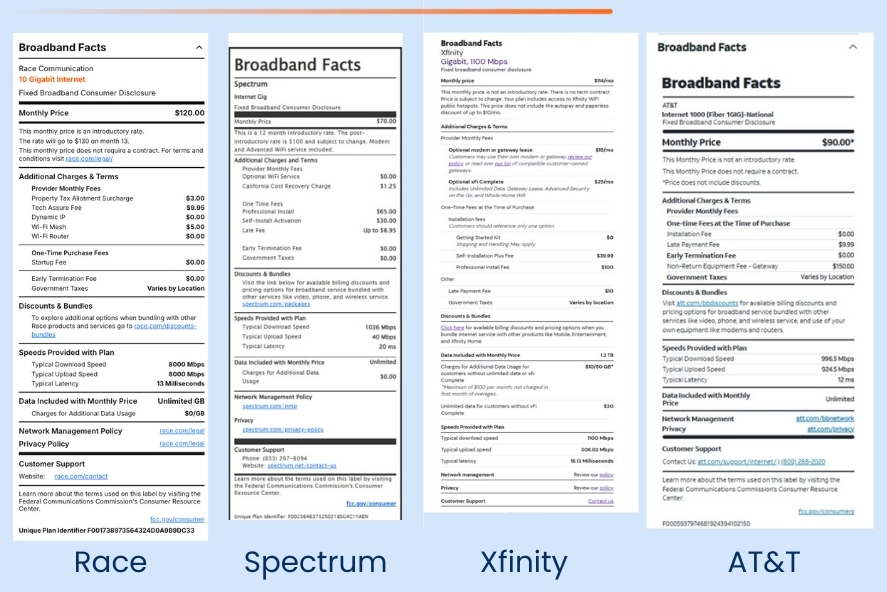
When you compare today’s broadband labels across major providers, it’s clear that not all connections are created equal:
- The Xfinity broadband facts might show 1,100 Mbps download speeds, but only 306 Mbps upload.
- The Spectrum broadband label caps uploads at a mere 40 Mbps, even on top-tier plans.
- AT&T broadband facts offer fiber in many areas, but they also have plans with traditional infrastructure, which leads to inconsistent performance and pricing.
- Xfinity imposes data caps, so you might be hit with extra fees and throttling if you go over the 1.2 TB tab.
See the broadband label comparison below:
Broadband nutrition labels also show that fiber internet providers stand out. They offer symmetrical speeds, meaning upload and download are equal.
While download speed is great for streaming Netflix or YouTube, upload speed is what powers smooth Zoom calls, fast file backups, livestreaming, and gaming. Many cable providers (like Spectrum and Xfinity) still offer slow upload speeds compared to fiber. That’s why symmetrical speeds are a must in 2026.
Aside from speed, fiber providers also come out ahead on latency, reliability, and transparency.
For example, Race Communications broadband facts label shows:
✅ No contracts
✅ Unlimited data
✅ Symmetrical gigabit speeds
✅ Free professional installation
✅ Low latency
✅ Router included
So while every provider now plays by the same labeling rules, fiber ISPs like Race have the facts to back up the marketing. And the new labels make those facts easier than ever to compare.
Choosing the Right Internet Plan Just Got Easier
For years, shopping for internet meant deciphering vague ads, hidden fees, and inconsistent plan details. But now, thanks to the FCC’s Broadband Facts labels, the fine print is front and center, and the facts speak for themselves.
Whether you’re reviewing the Xfinity broadband facts, the Spectrum broadband label, or the AT&T broadband facts, one thing is clear: fiber internet providers consistently offer better performance, clearer pricing, and fewer limitations. From symmetrical speeds to unlimited data and contract-free options, fiber simply delivers more value.
At Race Communications, we’re proud to stand out for all the right reasons.
See the facts for yourself
Race Communications delivers fiber internet, then puts the facts on the table. Check availability in your area and view our Broadband Facts before you sign up.
Check availabilityQuestions? Call 877.722.3833
Frequently Asked Questions
What are Broadband Facts labels?
Broadband Facts labels are standardized, one-page fact sheets that show the key details of an internet plan, including price, speeds, data limits, and fees. The FCC modeled them on food nutrition labels so you can compare providers using the same format.
Are broadband labels required by law?
Yes. The FCC requires most internet providers to display Broadband Facts labels at the point of sale, and the rules took full effect for providers in 2024. Providers like Xfinity, AT&T, Spectrum, Frontier, and Race Communications all present plans using the same format.
Where can I find a provider’s broadband label?
Providers must show their Broadband Facts label at the point of sale, both online near the plan details and in stores. Because every label follows the same layout, you can open two providers side by side and compare them line by line.
Why do upload speeds matter on a broadband label?
Upload speed controls how well you can send data, which powers video calls, file backups, livestreaming, and gaming. Many cable plans list much lower upload than download speeds, while fiber plans usually show symmetrical speeds, meaning upload and download are equal.
Does the monthly price on a broadband label include everything?
Not always. The label shows the base monthly price, which may be an introductory rate that rises after a few months. Check the final price after any promotion ends, plus one-time fees and any monthly equipment charges, so you understand the full cost.
What is latency on a broadband label?
Latency is the response time of your connection, measured in milliseconds. Lower latency means less lag, which matters most for gaming and video calls. On a label, latency under 30ms indicates a responsive connection.
Does Race Communications have a broadband label?
Yes. Race Communications publishes a Broadband Facts label for its fiber plans using the same FCC format as every other provider. You can review the full details, including price, speeds, data, and fees, when you check availability and view a plan in your area.